Prepared October 25, 2026 (Asia/Seoul) · Market snapshot: October 1, 2026 · Currency: USD
Brickell is worth considering if being close to its financial district and shopping anchors would improve your daily routine. Downtown deserves a place on your shortlist if its locations and available units fit your budget better. Neither neighborhood is automatically the better condo purchase: the building’s finances and your total ownership cost can change the answer. This guide compares asking prices, explains why neighborhood averages can mislead, and shows what to check before making an offer.
Key Takeaways
- Compare the same bedroom count, usable space, building condition, and ownership structure before judging value.
- Asking prices describe what sellers want; recent closed sales help test what buyers will pay.
- Monthly association dues, assessments, insurance, taxes, and financing belong in the same budget.
- Review the building’s inspection reports and reserve funding, rather than relying on the lobby or listing photos.
- Choose the location that works for your routine, then require the individual building to pass your financial and physical checks.
First, Define “Downtown Miami”
“Downtown” can describe a broader urban area that includes Brickell. The Miami Downtown Development Authority publishes separate maps for the Brickell Financial District and Central Business District, illustrating why a neighborhood label needs a boundary. Miami DDA maps.
For the price comparison below, we use WIRE Miami’s own geographic classifications. Its Downtown category covers the City of Miami north of the river, east of I-95, and south of Edgewater; Brickell follows its search boundary. These are provider-defined markets, not interchangeable ZIP codes or a claim that all sources use the same borders. The dataset includes condominium, co-op, and condo-hotel listings. WIRE Miami methodology.
That matters when you move from browsing to buying. A conventional residential condo and a condo-hotel can have different operating arrangements. Identify the legal property type before comparing two apparently similar units.
Miami Condo Asking Prices in 2026: Brickell vs. Downtown
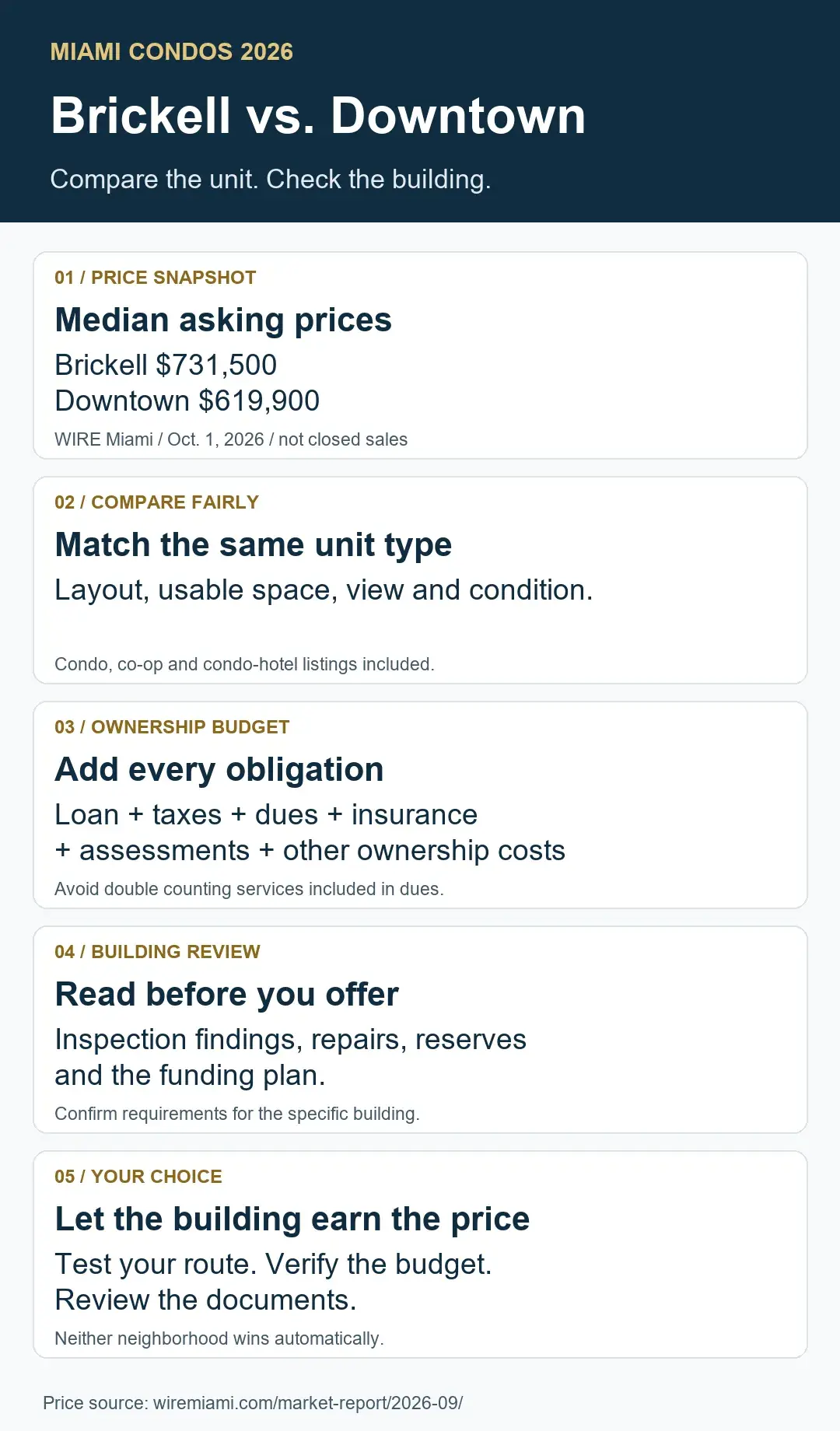
The following snapshot comes from WIRE Miami’s September report, refreshed October 1, 2026. Figures are median asking prices, not closed-sale prices.
| Listing category | Brickell | Downtown Miami |
|---|---|---|
| All covered residences | $731,500 | $619,900 |
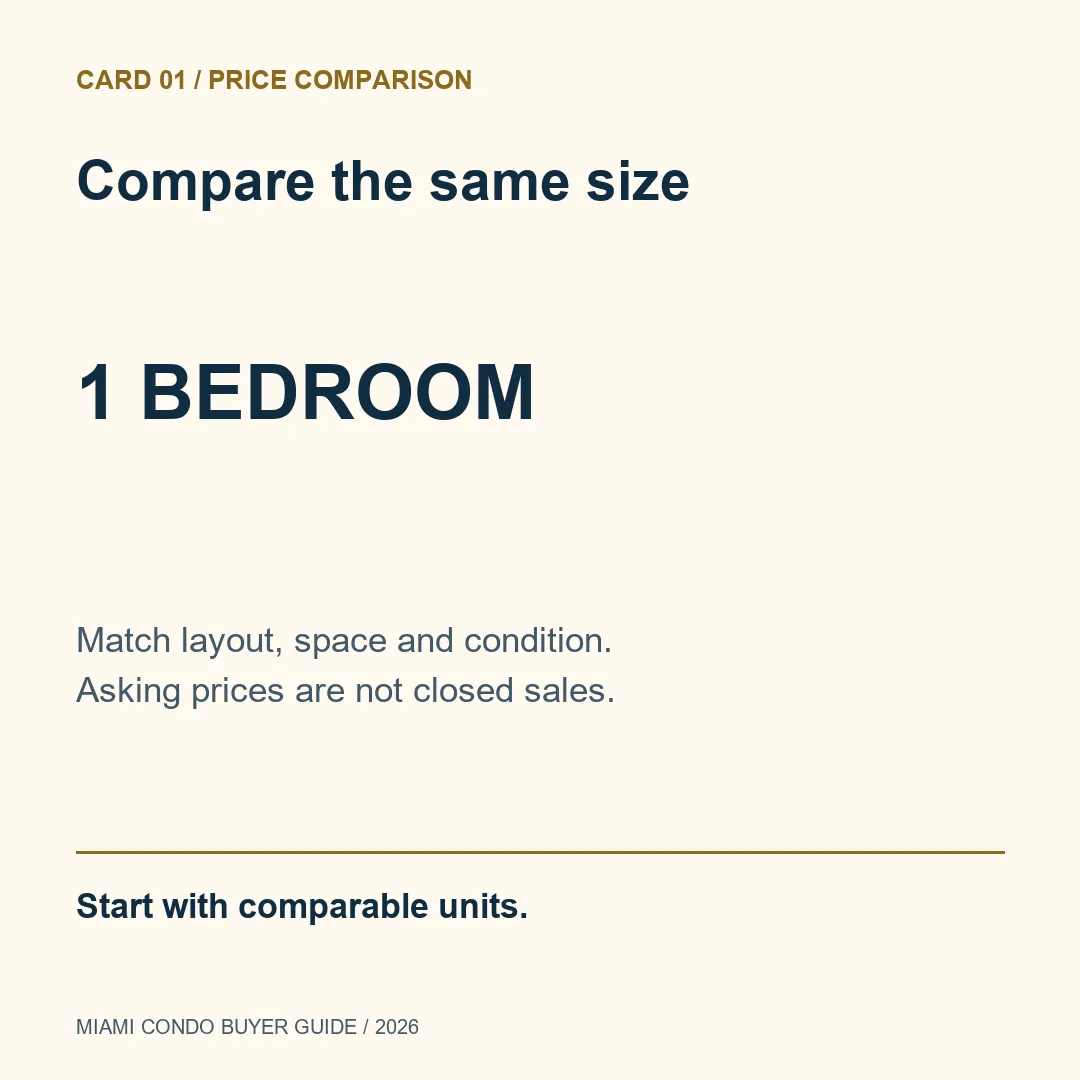
| One bedroom | $545,000 | $520,000 |
| Two bedrooms | $838,000 | $799,000 |
Source: WIRE Miami, September 2026 market report. These are one brokerage’s MLS/IDX compilation, not an independently audited census. Off-market transactions are not represented. The source does not measure closed-sale prices in this report.
The overall gap is about 18.0%, but it narrows to 4.8% for one-bedroom listings and 4.9% for two-bedroom listings, calculated relative to Downtown. Different mixes of units affect medians; these are not premiums for identical properties.
What You Should Ask Before Calling a Condo “Cheap”
Build a comparison sheet for the units you would actually buy:
- Same bedroom count and a comparable interior layout.
- Verified interior square footage, with balconies identified separately.
- Similar floor, exposure, view, parking rights, and renovation condition.
- The same intended use: primary home, second home, or legally permitted rental.
- Current association dues and what those dues include.
- Approved assessments, planned projects, reserve funding, and insurance terms.
Ask your agent or appraiser for recent closed comparables, preferably in the same building or competing buildings with similar characteristics. Confirm closing dates, concessions, condition, and assessment obligations. A stale asking price is not evidence that the property is worth that amount.
When Brickell May Be the Better Fit
Brickell is a logical starting point when your destination is the financial district or the area around Brickell City Centre. Miami DDA identifies a Brickell Financial District subdistrict, and the county lists Brickell City Centre as a Metromover destination. Miami DDA, Miami-Dade station information.
The practical question is how much that location is worth to you. If a particular building saves a commute or puts everyday errands on a route you like, paying more might be reasonable. That is a personal-use benefit, not evidence of superior future appreciation.
Walk the actual route from the building entrance to your destination. Check crossings, garage access, deliveries, elevator waits, and the trip home after dark. Visit at the times you would normally come and go. Conditions at one address should not be generalized to every Brickell building.
Choose Brickell when a specific location earns its cost and the building’s records support the purchase. Do not pay a neighborhood premium before checking the association’s obligations.
When Downtown May Be the Better Fit
Start with Downtown if your routine centers on destinations such as Bayside Marketplace, the Kaseya Center, or the Government Center area. County transit materials identify these destinations or connections within the Metromover network. Miami-Dade Metromover.
Compare the immediate blocks around each candidate building. A location convenient for your workday may feel different during an event or a weekend. Test the walking route, loading access, garage circulation, and noise inside the unit with the windows closed.
For a budget-focused buyer, the right question is whether a particular Downtown unit leaves more room for other priorities after recurring expenses and known projects. A lower purchase price loses some of its appeal if it comes with costs you have not budgeted for.
Choose Downtown when an actual unit offers the location, space, and documented costs you need. Its neighborhood label alone cannot establish that it is a bargain.
Both Areas Have Transit — Check Your Specific Trip

Miami-Dade operates the free Metromover in the Downtown, Omni, and Brickell areas, with connections to other transit. Check current service notices, accessibility, and the complete route before relying on it. As of this review, the county reports a temporary Financial District station closure beginning October 24, 2026, for approximately five weeks, with Brickell Loop trips beginning and ending at Brickell station. Verify service before traveling. Free Metromover travel does not mean every connecting service is free. Official Metromover information.
Test your actual trip rather than assuming that living near a station eliminates the need for a car. Include the walk to the platform, transfers, weather exposure, and the return trip. If you will drive regularly, compare assigned parking rights and any separately charged parking costs in writing.
The Ownership Budget Matters More Than the Mortgage Quote
For each unit, calculate:
Monthly ownership budget = principal and interest + property taxes ÷ 12 + association dues + owner-paid insurance ÷ 12 + assessment payments + utilities and parking not already included + an interior maintenance allowance.
Avoid double counting: some services or insurance costs may already be included in association dues. Ask an insurance professional what remains the unit owner’s responsibility.
A Hypothetical Cost Check
Consider a $600,000 purchase with 20% down and a 30-year fixed mortgage at an assumed 6.5% interest rate. The loan is $480,000, and the calculated principal-and-interest payment is about $3,034 a month. This is an illustration, not a current rate quote or APR.
| Illustrative expense | Monthly amount |
|---|---|
| Principal and interest | $3,034 |
| Association dues | $1,200 |
| Property taxes: assumed $9,000 annually | $750 |
| Owner-paid insurance: assumed $1,800 annually | $150 |
| Utilities and parking not included above | $200 |
| Interior maintenance allowance | $150 |
| Known assessment payments | $0 |
| Illustrative monthly budget | $5,484 |
All inputs are hypothetical and are not neighborhood averages. The example excludes closing costs, moving expenses, furnishing, lost returns on the down payment, and future cost changes. Mortgage insurance, additional fees, or other charges may apply to a different loan or property.
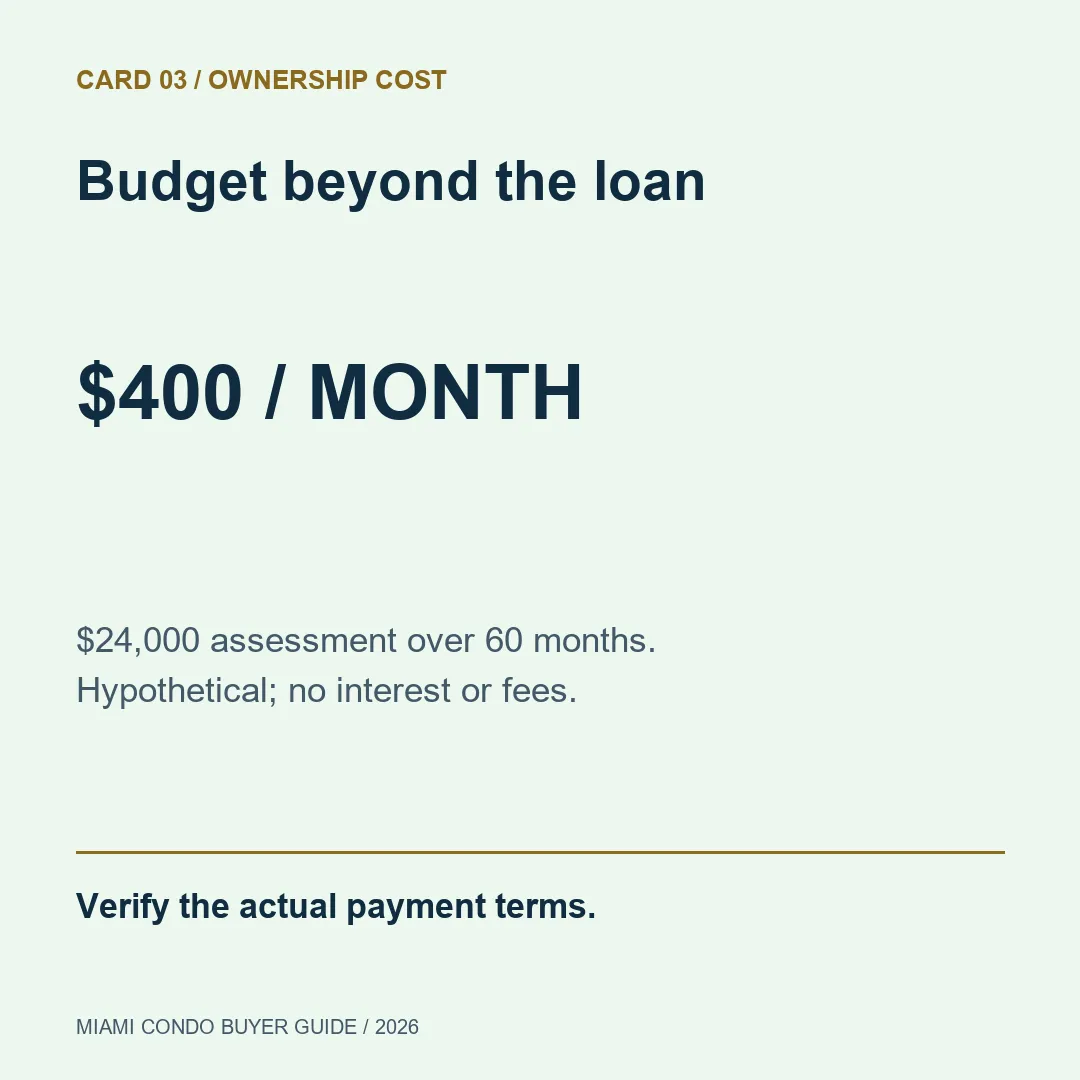
Now add a hypothetical $24,000 assessment payable over 60 months with no interest or fees: that is $400 a month, raising the budget to approximately $5,884. An association can require a different payment schedule; do not assume installments are available.
This is why a lower purchase price cannot settle the Brickell-versus-Downtown decision. Compare the budget and the cash needed at closing for each actual unit.
Recalculate Taxes for the Buyer
Miami-Dade’s Property Appraiser warns that a seller’s current or previous taxes may not predict the buyer’s future bill. A sale can remove an assessment limitation, and exemption eligibility also matters. Use the county’s estimator with buyer-specific assumptions and verify the result; it produces an approximation, not a tax bill. Miami-Dade tax estimator.
Florida Condo Inspections and Reserves: Review the Documents
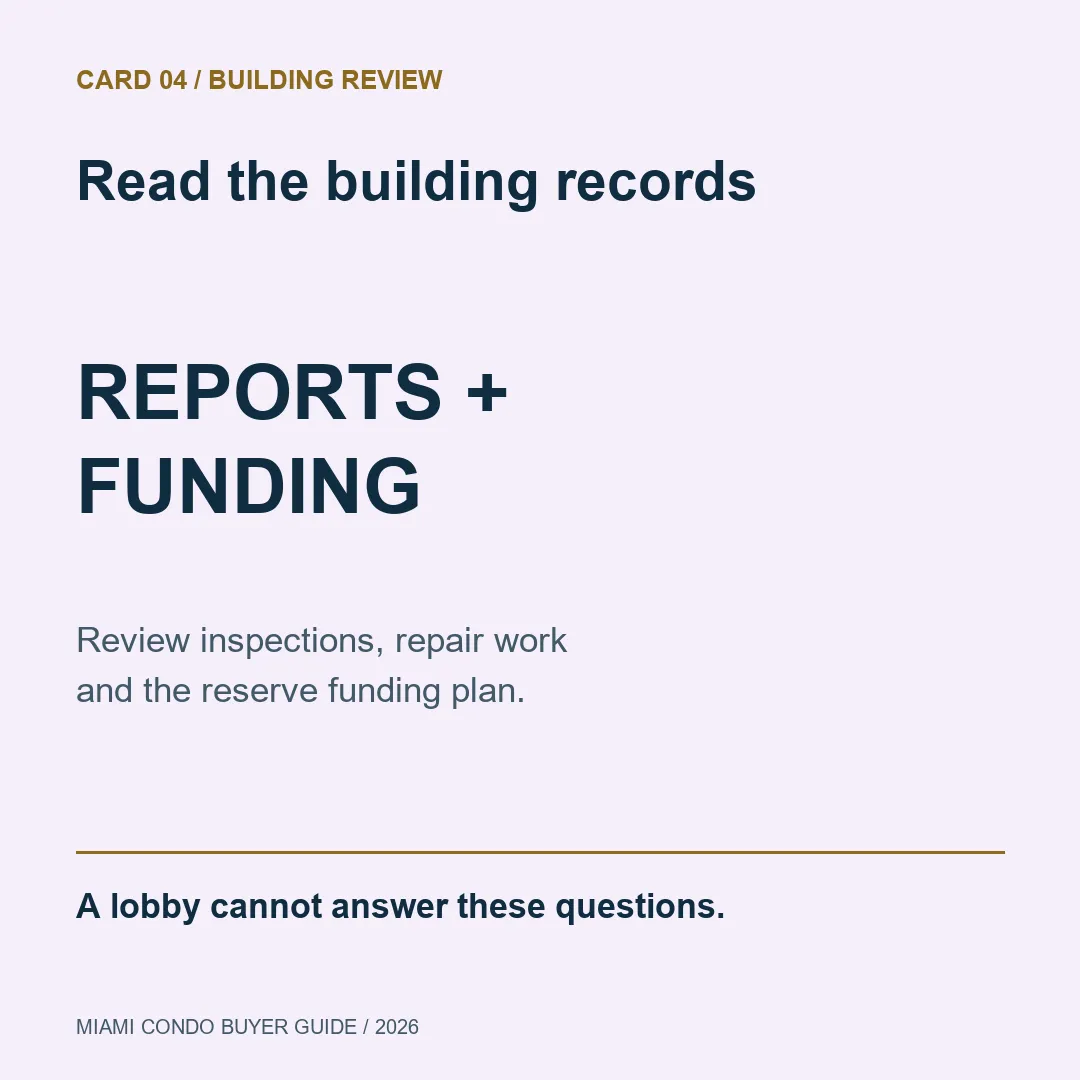
A milestone inspection addresses structural condition; a Structural Integrity Reserve Study (SIRS) addresses planning and funding for covered major repairs and replacements. They answer different questions. Florida DBPR inspection and SIRS guidance.
Florida’s milestone-inspection statute generally covers residential condominium and cooperative buildings of at least three habitable stories, with an initial inspection at 30 years and every 10 years afterward. Local enforcement agencies can require the initial inspection at 25 years based on local circumstances. Do not assume a uniform 25-year rule applies to every coastal building. Confirm the specific building’s notice, inspection history, and accepted deadlines with the local building department. Florida Statutes §553.899.
DBPR describes a conditional provision allowing certain associations with a milestone inspection due on or before December 31, 2026, to complete SIRS alongside it, by that date. It is not a blanket extension for all associations. Confirm applicability and current funding requirements with the association and a Florida attorney. DBPR SIRS deadlines.
Request the current budget, financial statements, reserve study and funding plan, available inspection reports, repair scopes, assessment notices, and recent board minutes. Ask how approved work will be paid for and whether the proposed budget changes your dues.
An inspection report does not itself prove that repairs have been finished or fully funded. Request completion documentation and payment information where work has been required. A new building also needs document review; new finishes do not answer questions about operating costs or contractual obligations.
Insurance, Flood Exposure, and Rental Plans Need Separate Checks
Look up the property’s official flood-zone information. Miami-Dade explains that lower mapped risk does not eliminate flood risk. A neighborhood-wide label cannot replace an address-specific review. Miami-Dade flood-zone resources.
Ask an insurance professional to review the association’s master coverage, deductibles, exclusions, and renewal terms alongside your unit-owner coverage. Confirm how damage to shared systems, garages, and access areas could affect your budget and use of the property. Do not infer coverage from the floor number or the association’s insurance certificate alone.
If rental income is part of your plan, obtain written confirmation of the governing documents, minimum lease terms, approval procedures, fees, and applicable city and county requirements. A listing’s “Airbnb-friendly” description is not sufficient due diligence. This article does not verify rental eligibility for any building.
Evaluate an investment with a property-specific operating statement: rent assumptions, vacancy, management, cleaning where relevant, maintenance, dues, taxes, insurance, assessments, debt service, and eventual sale costs. Projected gross rent is not net cash flow.
Brickell vs. Downtown: Which Should You Choose?
| Your priority | Where to start | What must still check out |
|---|---|---|
| A routine centered on Brickell’s financial district or City Centre | Brickell | The exact walk, total cost, and association records |
| A routine centered on Downtown destinations | Downtown | Your block, route, noise tolerance, and building costs |
| The lowest sustainable ownership budget | Compare both | Buyer-specific taxes, insurance, dues, and project funding |
| Rental income | Compare eligible buildings in both | Written rental permissions and a realistic net-income model |
| Fewer unresolved building issues | Compare documents in both | Inspection findings, repairs, finances, and insurance |
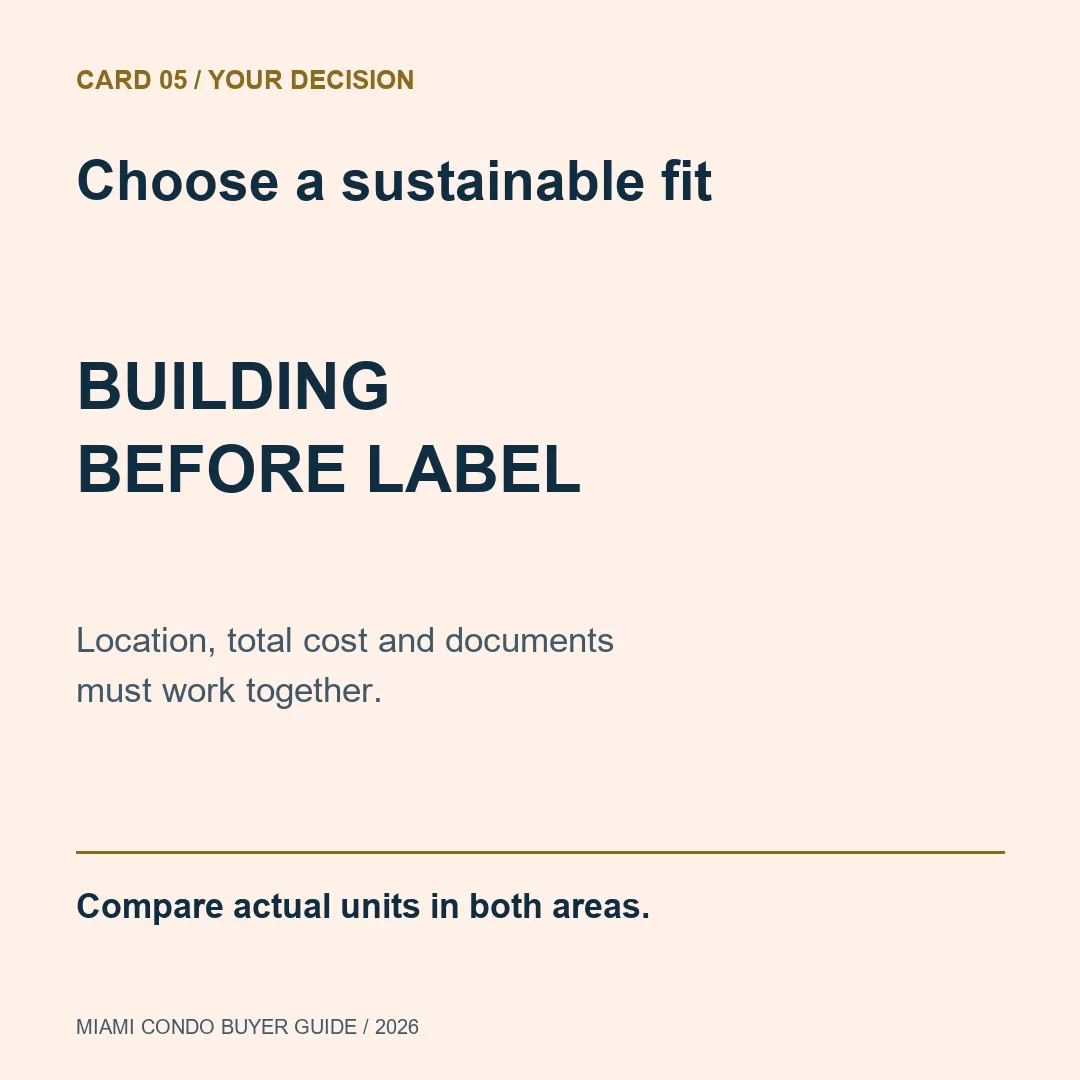
The Wealth Warrior perspective is to choose the building before declaring a neighborhood the winner. Location should earn its place in your budget, but a purchase should also survive a review of the association’s records and your own cash needs.
Before you offer, set three limits: your maximum purchase price, maximum monthly ownership budget, and cash reserve for known or plausible additional costs. Ask your lender to review the actual condominium project early, and have a Florida real estate attorney review the contract, document rights, assessment allocation, and deadlines before you become bound.
If neither shortlisted building passes those checks, broaden the search or wait for a better-supported option. There is no need to predict a neighborhood’s next price move to reject a purchase whose present obligations you cannot comfortably carry.
Sources and Method
Research checked October 25, 2026 (Asia/Seoul). The price table is a fixed October 1 snapshot; it is not a full-year 2026 result, a forecast, or a live quote. We reviewed the publisher’s methodology and recalculated the price gaps, but did not access transaction-level MLS records or independently reproduce its medians. Building-specific documents and insurance or mortgage quotes were not obtained.
- WIRE Miami: September 2026 market report, updated October 1 — price table and dataset scope.
- Miami DDA: maps and district boundaries — geographic context.
- Miami-Dade: Metromover and Brickell City Centre station — transit context.
- Miami-Dade Property Appraiser: tax estimator and cautions — buyer tax considerations.
- Florida DBPR: inspections and SIRS and Florida Statutes §553.899 — inspection and reserve context.
- Miami-Dade: flood-zone maps — official address-specific starting point.
Disclosure: This article is for informational and educational purposes and is not personalized investment, legal, tax, insurance, or mortgage advice. Real estate can lose value, and ownership expenses can change. Verify current documents and requirements with the association, local authorities, lender, insurer, and appropriately licensed professionals. You are responsible for your purchase and investment decisions.
For educational purposes only. This article is not individualized investment, tax, or legal advice. Investments can lose value; property ownership involves costs and risks. Check current official information and seek qualified advice for your circumstances.